On Monday I had the day off, and decided to go to the National Army Museum in London to see the Commando exhibition. As it wasn't a weekend (like it is when I go to comic conventions) the Underground was actually working! The museum itself is a fair walk from the station, past the Royal Chelsea Hospital. The houses round that way are nice, mind you.
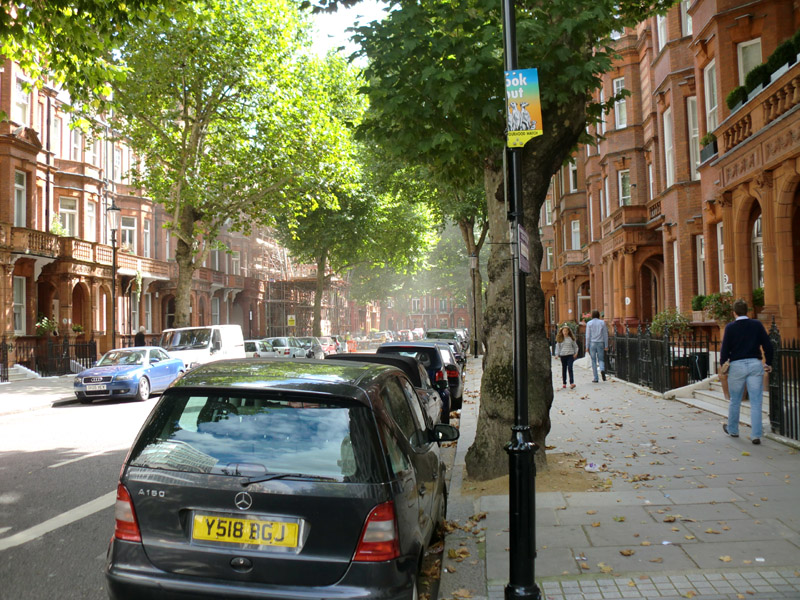
When I rule my own country this is what the narrowest streets will look like.
Anyway, after the walk I reached the museum, which has a banner outside advertising the exhibition. It did start on the first of this month though, the banner may not stay until the end! The museum itself is deceptively small on the outside, the inside is full of maze-like small rooms crammed with informative exhibits. The actual army exhibition part goes forwards in time as you climb the stairs, the first hall is about the New Model Army, for instance, whilst the one closest to the exhibition (on the top floor) is about 40's and 50's National Service. Naturally there's also sections on the Falklands and the Troubles nearby.
 -
-

The Commando exhibition itself is actually quite small, and confined to one room. It's primarily dedicated to original cover artwork, which is no bad thing as the work of Ken Barr, Jose Maria Jorge et al is beautiful! There's a mixture of ages too. DC Thomson are great at keeping their original artwork, which allows for top-notch reprints. They even have the original art for the very first issue, which will be reprinted shortly. You aren't supposed to take pictures, and a small bloke who might have been a Gurkha caught me. But here's one of the ones I managed to smuggle across the lines!

50 years old and it looks like the paint’s barely dry!
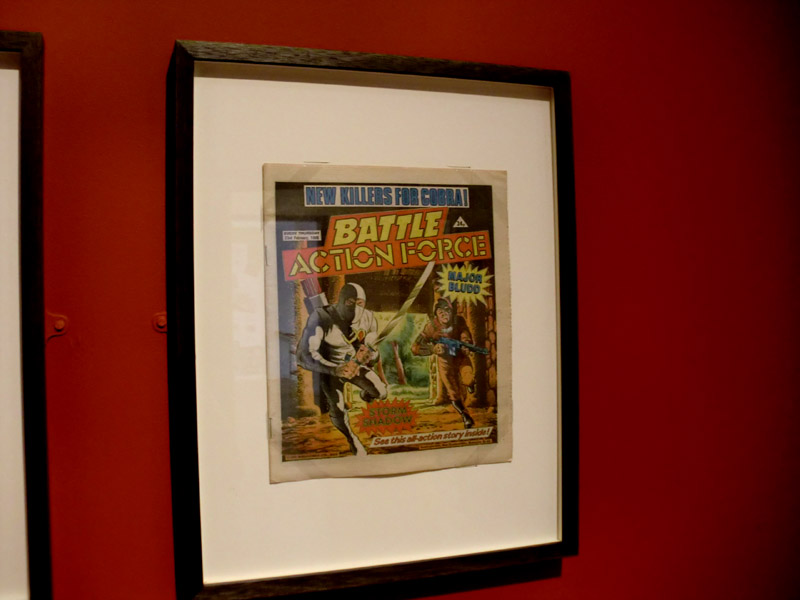
Apart from the cover artwork, there's actually disappointingly little else, but only so much of a "serious" museum can be turned over to "mere comics". There's a very brief history of boys' adventure comics, mentioning The Boys’ Own Paper (with a 1916 monthly issue on display), examples of Commando's IPC competitors, a mention of The Victor and a copy of "Battle Action Force". The latter is an odd choice; Battle Picture Weekly (later Battle Action) is regarded as one of the greatest British comics ever, but Battle Action Force was just a stupid toy catalogue disguised as a comic (though unfortunately a sign of things to come). "Action Force" was the name under which the smaller 1980's GI Joe figures were breifly sold in the UK (the original, big, GI Joe was sold as "Action Man", which later became it's own thing).
There's also one small cabinet featuring some authentic Commando equipment such as a silenced Sten Gun, a Commando knife, a few berets (and a helmet with a nasty-looking hole!). Behind it is a painting of the famous Saint Nazaire raid of World War 2, which wrecked a vital drydock in France, and greatly hampered Germany's ability to repair large ships.
 -
-


Unfortunately there's almost no interior artwork (I'd love to see the fine lines of Jose Maria Jorge up close!) but there are some other interesting items – examples of the “transparencies” that used to be laid over the artwork. These have the comic's logo, the knife and the title painted on them. They also have the cover of issue 11 "Closer Than Brothers" assembled with it's transparencies, as it would have been back in 1961 for the printers! Of course today all of that is added to the art digitally instead.
One final, important, detail is that a couple of the descriptions lament the fact that comics are not taken seriously in Britain, and that the hard work of writers and artists deserves to be recognised and remembered much better than it is. Hopefully this display will be a small step in that direction!
In the museum's shop the 50 Years a Home for Heroes book is on sale. It will be in bookshops at the end of the month. It's about as thick as an annual but very large!
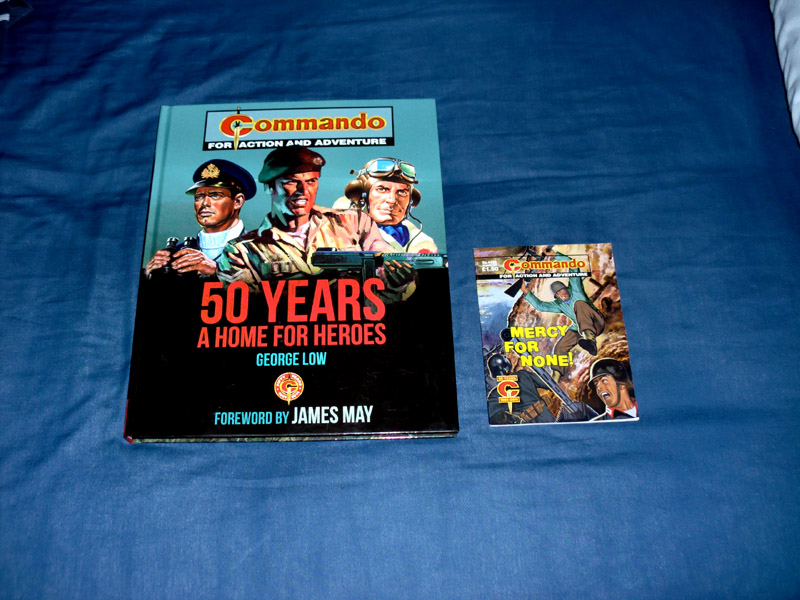
Like so
As well as a general history of Commando, it also contains articles on writers and artists ("general overview" articles rather than ones for individuals, unfortunately) with some amusing anecdotes and insights into their working methods.

With scattered-around bits of cover art. Here's where keeping the originals comes in handy!
There's also six issues of the comic reproduced in full (something many other comics coffee table books could learn from!). The pages are reproduced at the print size, with four pages on one page of the book. The covers are also reprinted in full colour - something else other books could learn from!

Of course, the late, great Jose Maria is represented!
Finally, the reprinted stories have introductions with big blow-ups of the cover art. There's also some interesting detail on the stories, such as how they were developed with the writer, editor and artist. These pages look magnificent, and the whole book is printed on thick, heavy matte paper that really shows off the art.

Must be about the original size of the paintings!
In spite of it's small size, this exhibition is well worth visiting. The nearest underground station is Sloane Square. From there go left down the street in the picture above, then left again and right at the crossroads past the Royal Chelsea Hospital, then just go straight! Entry is free and there's plenty of other to look at in the building, too. There was an exhibition about people sheltering in the underground during the Blitz, with a copy of The Wizard poking out of a kid's schoolbag!