
Which is very difficult to take a decent picture of
What do you suppose is the one, single mention of British comics in the Kyoto International Manga Museum? (well, to be fair, American-published, British-made works like V for Vendetta and Watchmen are almost directly in front of you once you go through the ticket barrier). It must be one of the more famous ones, like The Dandy or The Beano, right? Nope! Well then, what about famous "modern" adventure comics like 2000AD, Action, or Battle Picture Weekly? No, it's not them either... How about the well-known Eagle? Not even hinted at! And neither is Roy of the Rovers, the longest-running title devoted to our national game.
What else could there be? How about Newspaper strips? Now you're on the right track... Modesty Blaise, perhaps? Nope! Garth? Nope! Not even Andy Capp... and even Homer Simpson reads Andy Capp! In fact, the only British comic to be mentioned in the Kyoto International Manga Museum is... THIS!

Well okay, that'ss actually the annual based on the newspaper strip.
Pip, Squeak and Wilfred, as the main strip was known (in the 1920's, there was a separate Wilfred annual for younger readers) first appeared in the Daily Mirror in 1919, initially drawn by Austin Bowen Payne. The writer was Bertrand Lamb, or “Uncle Dick”, as he called himself in editorial segments. A.B. Payne left the strip sometime in 1939, and from then on it was drawn by uncredited artists. The strip finally ended in 1956, having run in the Mirror (presumably) daily, and also having produced two series of annuals – one pre-war, and one post-war. The first Pip & Squeak and Wilfred annuals appeared in 1922, cover-dated 1923, and it’s the first of these that I'll be looking at to start with.
 –
– 
As the annuals are aimed at young readers (apparently the Wilfred annual was aimed at younger readers still, it was probably designed for parents to read to their children, whereas this one is for the children to read themselves), they have a lot of colour. Though this is 1922, so the full colour pages are limited to a few plates, but many of the others have red spot colour, or blue ink.

The book begins with a rather long introduction, in which Uncle Dick reminds readers that blackcurrant jam is not good for annuals, and that puppies are likely to think there"s a mouse hiding inside it. He also introduces the characters, and their origins, Pip was apparently a stray dog, Squeak was born on an arctic island near South Africa, and later came to London. Wilfred was found in a field, having wandered away from his burrow. Other characters included Angeline, who is Uncle Dick's maid, and who looks after the animals, and Bendy, who is a half-fairy girl.
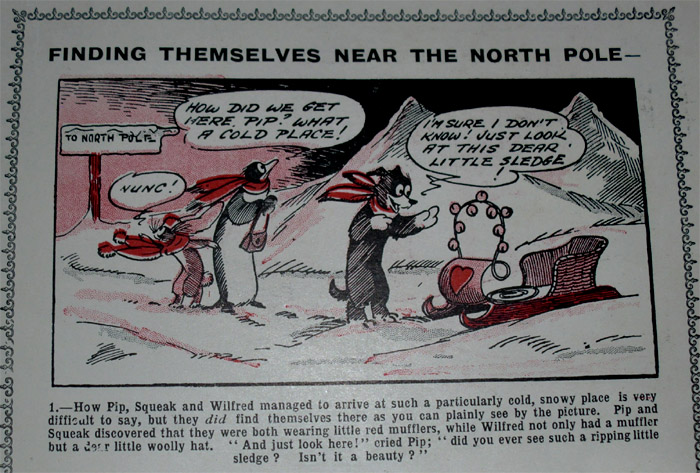
After the introduction, we go on to the first comic strip, which is in the "big caption" style of the time. In addition to speech balloons, a written story underneath explains what is happening, though this usually just repeats what you can already see!
They also meet Santa, who apparently has loads of toys stuck to the outside of his house
There's also several text stories, though they're still quite simple compared to those in "typical" annuals of the period (and the later 'mixed age' annuals like Feathers*). Including this genteel tale of shipwreck, the only real danger the characters (some boys and girls, not Pip, Squeak and Wilfred) face is their dog getting stuck in a hole. They also stumble upon an incredibly convenient Frigate Bird (apparently the South Sea Islands' version of a Carrier Pigeon) which they use to send for help.
2025note: to be reviewed somewhen or other

Then there's this "story without words", featuring Wilfred. Though you will quickly notice that it does have words! What's going on there? Well the sounds like "Boo Hoo!", "Nunc!" and "Gug!" that Wilfred made formed his entire vocabulary until the postwar period. "Nunc" was apparently his pronunciation of "Uncle", which is what he considered Pip to be. "Gug" and "Nunc" later took on another meaning, but I'll come to that further down!

There's also a few puzzle and hobby pages. Apparently some later "Uncle Dick Annuals" had lots of puzzle pages you could solve, cut out and send in for prizes, though the ones in this annual are just for fun.
 –
– 
Finally, there's some poems, with wonderful illustrations, and nice calligraphy on the writing, too. It may even have been drawn onto the original artwork, rather than printed later.

Of course, the main Pip, Squeak and Wilfred strip was appearing in the Daily Mirror. From 1921 to 1924 it was given it's own Saturday supplement, initially of four pages (though I should think the other three pages contained the Mirror's other strips, of which there used to be great numbers), but this was later reduced to three pages, then two. In the 50's, the Mirror had spread it's comic strips across almost every page of the paper, though more recently they have all been crammed together, next to the horoscopes.
The strip had a tremendous cultural impact during the interwar period, more than any British-made comic strip could hope for today. Pip, Squeak and Wilfred became the nickname for the three medals the "old contemptibles" and Kitchener's volunteers received for surviving the whole First World War. In addition, three RAF training aircraft of the interwar period were named Pip, Squeak and Wilfred, as were some armoured cars in service in Iraq. Handley-Page also named their HP39 aircraft "Gugnunc" in Wilfred's honour, and a small operation to mine the Norwegian coast in 1940 was codenamed "Operation Wilfred".

Also showing how Pip, Squeak and Wilfred occupied a whole page of the paper in 1928!
More importantly, and recorded on a double-page spread in the Gravett & Stanbury Great British Comics book, was the establishment of a huge fanclub called the Wilfredian League of Gugnuncs, or W.L.O.G. This was organised into "Burrows" and "Warrens", and at one pointed counted thousands of members throughout the Empire and wider world. The W.L.O.G. had a number of rules encouraging "Gugnuncliness". These included being kind to animals, protecting younger children, and never eating rabbit! There was even a blue-and-gold enamel badge for club members to wear.

Swiped from an Ebay auction (I later bought it!)
The W.L.O.G. reached it's height on the 14th of April 1928, when eight thousand members of the club flocked to the Royal Albert Hall for a mass celebration, an "appearance" by the characters and even a live performance of the club's song, The Gugnunc Chortle, on BBC Radio. This can also be found in the book, and goes:
Gug! Gug! Nunc! Nunc!
Gugnuncs Merry are we!
We sing this song, for we all belong
To the W.L.O.G.
Stand By – Friends all-
Members merry and free!
For hand-in-hand goes the gugly band
Of the W.L.O.G.
Nunc! Nunc! Wilf! Wilf!
To Wilf we bend the knee,
To Wilf we sing, to the gugly king
Of the W.L.O.G.
Gug! Gug! Nunc! Nunc!
To Friends of all degree!
Give gugly hugs to the nuncly gugs
of the W.L.O.G.
Apparently this was recorded and sold on a gramophone record, as were other Gugnunc songs, though they are extremely rare today… so somebody decided to re-record one from sheet music!
https://soundcloud.com/stanley-bad/the-gugnunc-song

In addition to those records, and the annuals, a few other books appeared (including a compilation of the first newspaper strips, published in 1921) as well as jigsaw puzzles, games, toys etc. At the height of the strip's fame, a huge model of Pip, Squeak and Wilfred's house, Mirror Grange, went on tour around the country, and featured walls that could be opened, to reveal the rooms inside. I found an old Independent article which seems to indicate the model was still in existence in 1995, though there doesn't appear to be any more recent information on it, nor Google Images pictures (though apparently it had a book to itself published during the tour!).

Though Pip, Squeak and Wilfred once had a huge cultural influence (apparently dwindling in the post-war period, with Wilfred now speaking properly, and a young penguin called Stanley, previously only occasionally seen, becoming a full-time member of the cast), they're largely forgotten today. Except among British humour comic fans, and antique toy / militaria collectors, anyway.
So why are they featured in the Kyoto International Manga Museum? Well they only appear as part of a display in what might be called the "centre" of the museum, which focuses on the evolution of manga. The middle of the room has examples of how it developed, along with examples of the influences of western-style humour magazines (a reproduced cover of Japan Punch, inspired by Britain's Punch, is shown), while the outer edge of the room has year-by-year shelves going from 1947 onwards, with books you can take down and read (all in Japanese, of course... and the older ones are more modern reprints, not actual 1947 volumes!). It is in this room that Pip, Squeak and Wilfred appear, alongside a similar Japanese "funny animal" newspaper strip, showing how the comics of all nations have influenced one another down the years (though die-hard manga fans in the west will insist it's "unique" and "different" and somehow sprang into fully-formed existence at some point in 1947).
The other area that contains foreign comics is the lobby, which has a rather randomised collection of "manga from around the world". The USA being a load of Marvel / DC (and the odd "indie") graphic novels, France being Tintin, Asterix etc albums (if I remember rightly, in a rather random assortment of languages, though mostly Japanese). Oddly the sections for other Asian countries just feature translated Japanese manga, and not their home-grown comics. Further along there's a separate "English Manga" section, with the American-translated volumes we get in the UK. There's no section for British comics at all.
Or at least there wasn't in late summer 2012! I suggested a long list of titles they could collect and feature on one of the feedback forms (though should probably have added "Or, if you can't be bothered to collect and bind all them, at least fill a shelf with Titan and DFC Library books"). I'm going back to Kyoto next month (2025note: That being May 2014), so I'll see if the situation has improved... (2025note:It hasn't!)